What to Inspect on Your Commercial Roof After a Wisconsin or Minnesota Winter
Winter is not easy on your roof.
Winter in Western Wisconsin and Eastern Minnesota doesn't just sit on your roof. It attacks it.
Between November and April, a commercial flat roof in this region endures temperature swings from -20°F to 45°F — sometimes in the same week. Snow loads press down on the membrane for months. Ice dams form at parapets and drains. Freeze-thaw cycles open seams that were sealed fine in October. And when everything finally melts, the water has to go somewhere.
If you manage a commercial building in this part of the country, the first warm week of spring isn't just a relief — it's a deadline. That's when you walk the roof, or have it walked, to find what winter left behind. Because the damage that happened under the snow doesn't announce itself. It waits for the next rain.
This post covers the specific damage patterns caused by Wisconsin and Minnesota winters on commercial roofing systems — what to look for, where to look, and what to do about it. If you want the full year-round checklist, start with our 12-point commercial roof inspection checklist. This guide goes deeper on the seasonal stuff.
Why is a spring roof inspection critical in Wisconsin and Minnesota?
Most commercial roofing manufacturers require documented inspections to maintain warranty coverage. But even if your warranty didn't demand it, the math alone makes the case.
A seam that opened 1/8 of an inch under freeze-thaw stress in January will leak every time it rains in April. Left alone through spring and summer, that seam lets water into the insulation. Wet insulation loses its R-value permanently — it can't be dried out, only replaced. By the time you notice a ceiling stain in August, you're looking at a section replacement that could have been a simple seam repair in March.
The cost of a spring inspection is zero with American Eagle Roofing. The cost of skipping it is almost never zero.
What winter damage should you look for on a commercial roof in spring?
These are the specific things that WI/MN winters do to commercial flat roofs. They're listed in the order you should check them — drainage first, because that's where the most urgent spring damage hides.
1. Blocked or Damaged Drains
This is the first thing to check — before anything else. Winter debris, ice damage, and sediment buildup can partially or fully block roof drains, and a blocked drain on a flat roof in spring is a ponding problem within hours of the first heavy rain.
What winter does: ice forms inside drain baskets and expands, cracking or deforming them. Leaves and debris from fall that weren't cleared get compacted by snow. Scupper openings get clogged with ice melt sediment. Gutter hangers loosen from repeated freeze-thaw expansion.
What to do: clear every drain, scupper, and gutter on the roof. Test flow with a hose if possible. Replace any cracked drain baskets. If drains are chronically problematic, the drainage design itself may need attention — that's something a professional commercial roof inspection can evaluate.
We did a spring inspection on a multi-tenant office building in Saint Paul, MN where every drain basket on the roof was either cracked or deformed from ice expansion over the winter. The property manager had cleared the debris in the fall, but the baskets themselves couldn't survive the freeze. Water was ponding around every drain because the damaged baskets were blocking flow even with no debris in them. We replaced all the baskets and the ponding problem disappeared overnight. It's a small fix that prevents a big problem — and it's the kind of thing you only catch by getting on the roof in March.
2. Membrane Damage from Freeze-Thaw Cycling
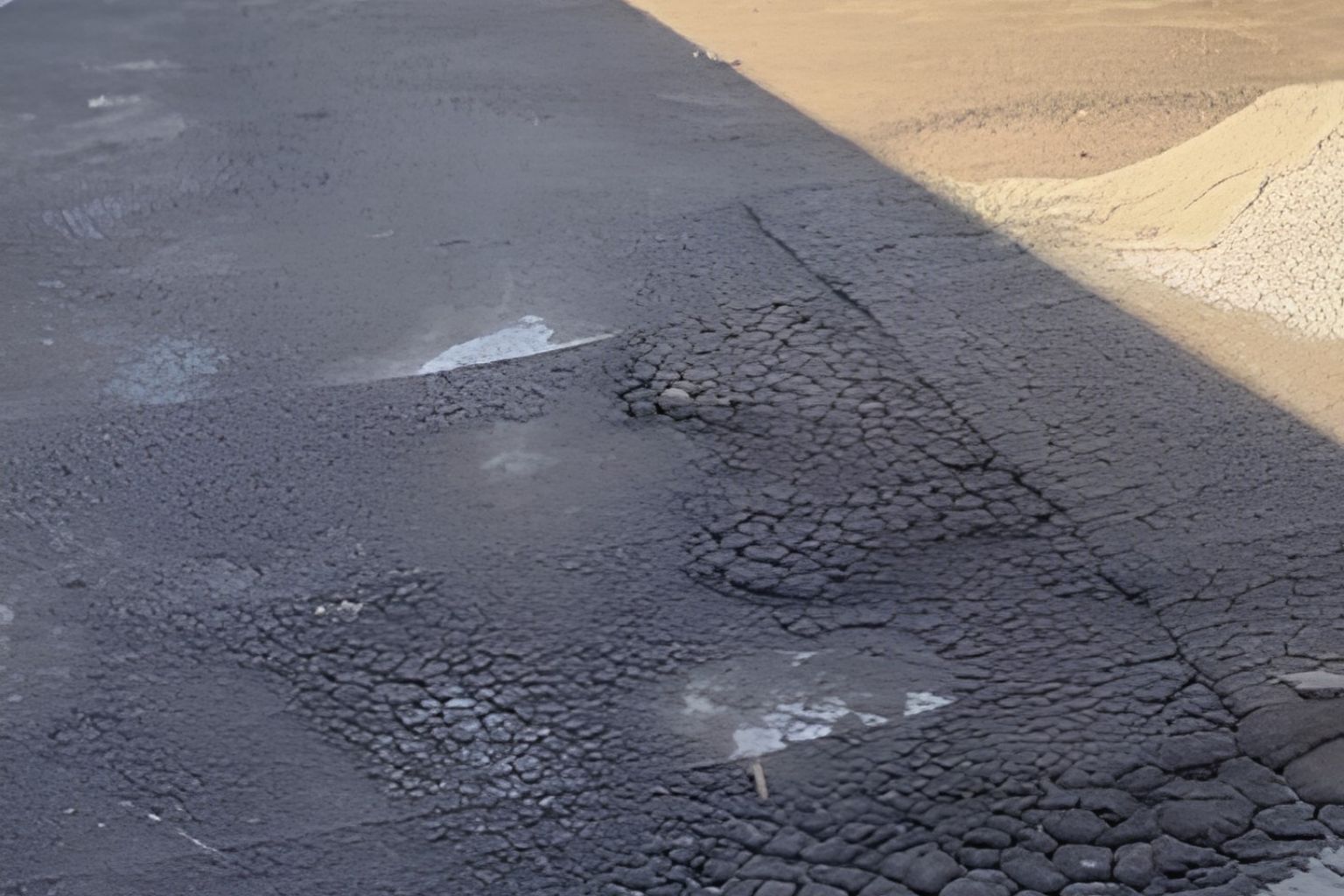
This is the signature damage pattern of a WI/MN winter. When moisture gets under or into a membrane surface and freezes, it expands. When it thaws, it contracts. Repeat that cycle 50-80 times between November and March, and the membrane surface cracks, blisters, or delaminates.
What winter does: surface cracking on EPDM and modified bitumen. Blistering where moisture was trapped under the membrane before the first freeze. Delamination of multi-layer built-up systems. Brittleness and reduced flexibility in older membranes that makes them vulnerable to foot traffic damage during spring maintenance.
What to do: walk the entire membrane surface. Look for cracking patterns, blistering, or areas where the surface feels brittle underfoot. Small cracks can be sealed. Widespread cracking or blistering means the membrane is failing — and this is exactly when a fabric-reinforced roofing restoration saves you from a full tear-off. Fabric-reinforced systems bridge existing cracks and create a new waterproof surface over the damaged membrane.
If you're not sure whether your membrane needs a patch, a restoration, or a replacement, our guide to choosing between fabric-reinforced and single-ply roofing walks through the decision.
3. Seam and Lap Failures
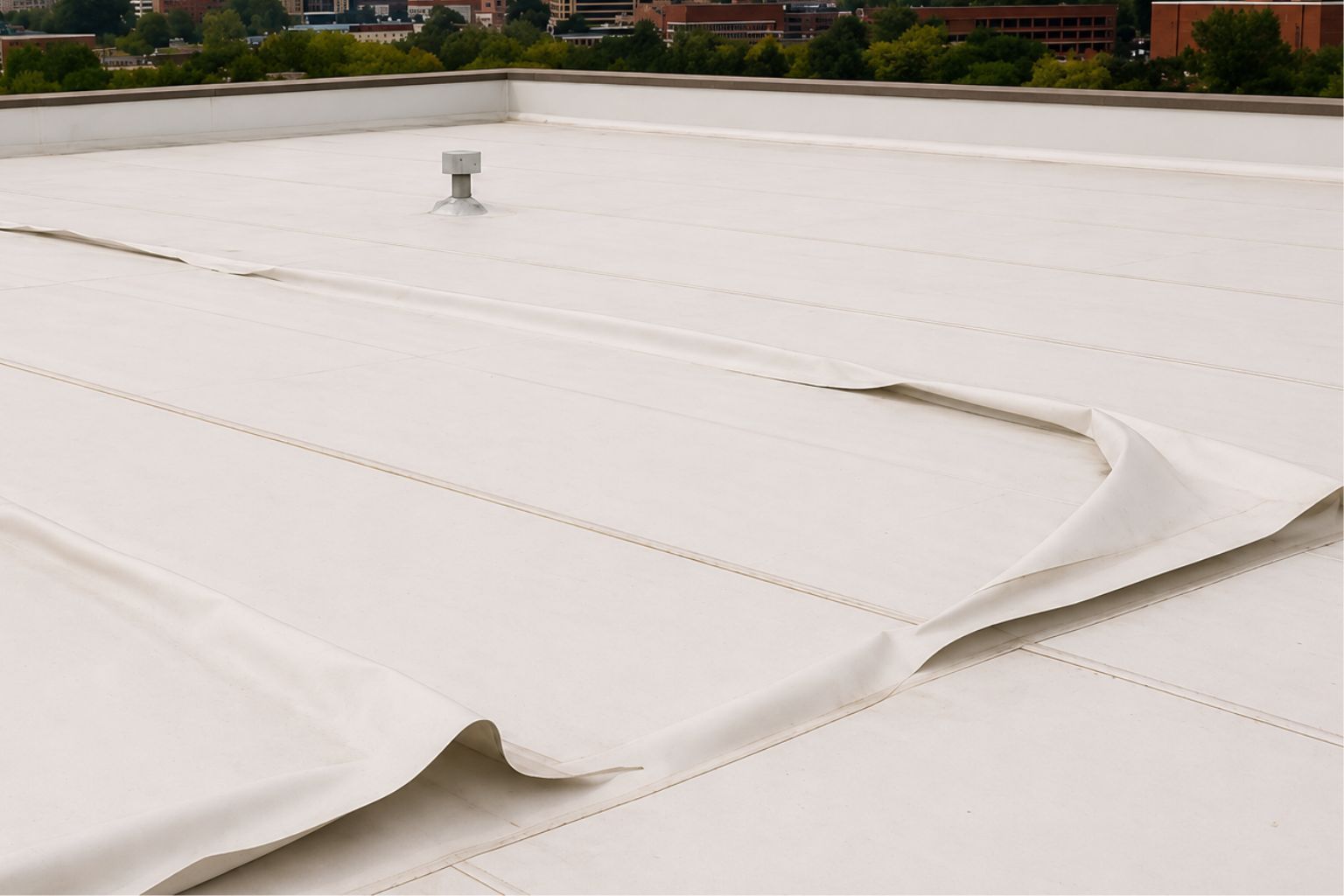
Seams are the most vulnerable part of any single-ply roof, and winter makes them worse. Thermal contraction pulls seams apart. Adhesive bonds weaken under sustained cold. Ice formation along seam lines pries edges open.
What winter does: heat-welded seams on TPO and PVC can crack at weld lines from thermal stress. Adhesive-bonded seams on EPDM lose bond strength after prolonged cold exposure. Lap edges lift or fish-mouth where ice formed underneath.
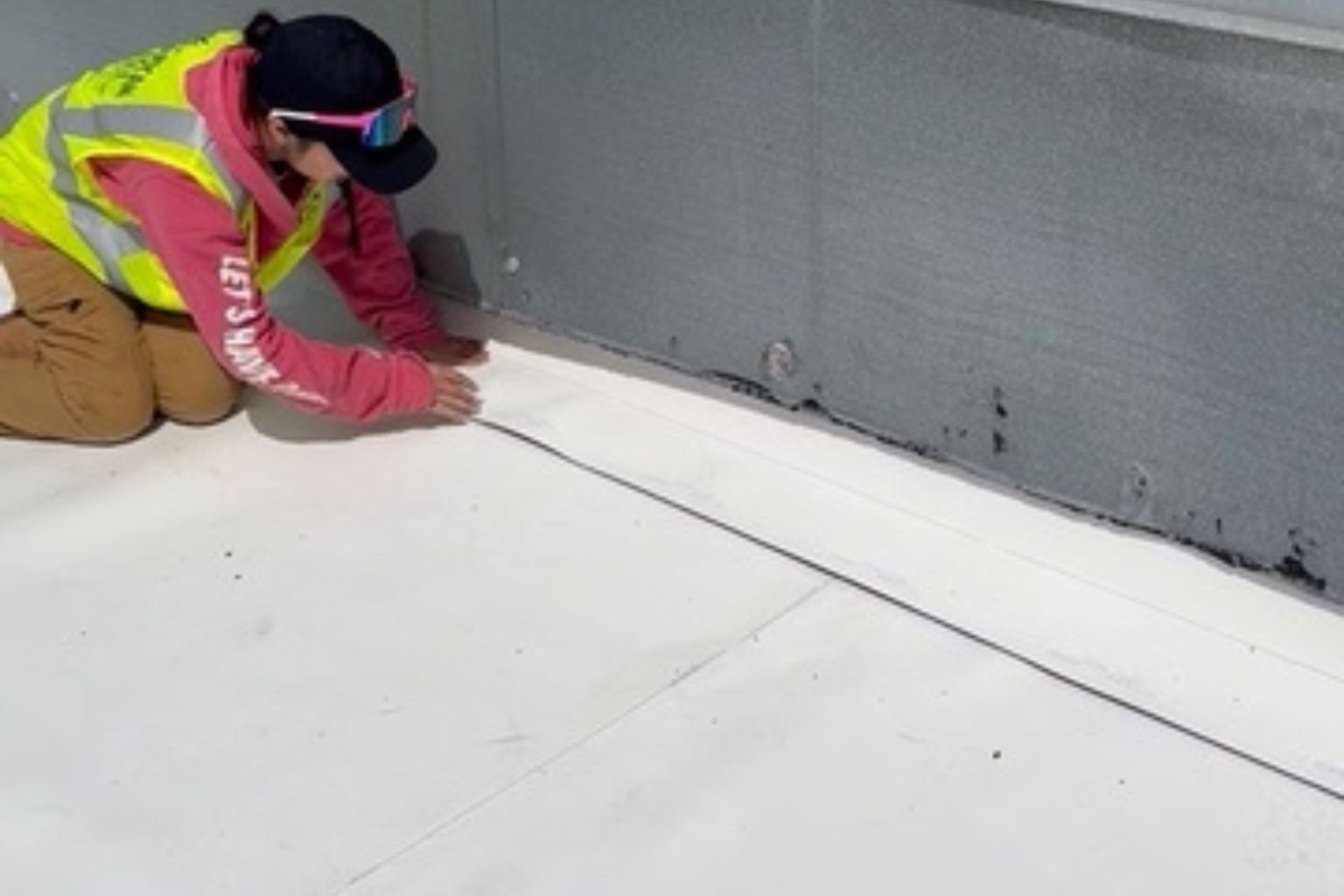
What to do: probe every accessible seam with a blunt tool (a rounded putty knife works). If you can slide it under the seam edge, the bond has failed. Any open seam is an active leak path. If failures are isolated, seam repair is straightforward. If you're finding open seams across multiple areas, the single-ply membrane system may be approaching end of life. For a detailed comparison of membrane types and their winter performance, see our TPO vs EPDM vs PVC decision matrix.
4. Flashing Separation
Metal flashings and the roof membrane they're attached to expand and contract at different rates. Over a WI/MN winter, that differential movement adds up. By spring, flashings that were tight in October are pulled away from walls, curbs, and parapets.
What winter does: sealant at flashing terminations cracks and separates. Metal flashings pull away from parapet walls, creating gaps. Counter-flashing embedded in masonry joints loosens as mortar cracks from freeze-thaw. Base flashing at HVAC curbs lifts where ice formed between the curb and the membrane.
What to do: inspect every flashing termination on the roof — parapets, walls, curbs, pipes, and edge metal. Any visible gap needs to be resealed or reflashed. Don't just recaulk a failed flashing — if the metal has pulled away, the sealant will fail again. The flashing needs to be mechanically resecured first.
After the winter of 2024-2025, we inspected a commercial property in Minneapolis, MN where the flashings along the parapet wall had pulled away by nearly half an inch in several spots. The building owner said the roof was "fine in the fall." It was — but 140 freeze-thaw cycles later, the differential movement between the metal flashing and the TPO membrane had created gaps you could fit a pencil into. Every one of those gaps was a leak waiting for the first April rain. We resecured the flashings mechanically and resealed the terminations. If he'd waited until the ceiling started dripping, the insulation underneath would have been the next problem.
5. Ice Dam Damage at Parapets and Low Slopes
Ice dams on commercial roofs form differently than on residential roofs, but the damage is just as real. On flat commercial roofs, ice builds up against parapets, around drain areas, and at any low point where water pools and freezes.
What winter does: ice expands against parapet walls, cracking mortar joints and displacing coping caps. Ice formation around drains lifts and damages the membrane in the drain area. Ponded water that freezes creates a sheet of ice that slides as it melts, pulling membrane and flashing with it.
What to do: check parapet walls for cracked mortar, displaced coping, and efflorescence (white salt deposits on the interior face — a sign water has migrated into the wall). Check drain areas for membrane damage. Look for any evidence of membrane displacement or stretching near parapets where ice sheets may have shifted.
6. Snow Load Compression Damage
Heavy snow loads compress the roof assembly — membrane, insulation, and deck. After the snow melts, the damage stays.
What winter does: insulation boards compress and lose R-value under sustained snow load, especially if they were already wet. Deck deflection creates new low spots that pond water. Membrane wrinkling or buckling appears where the deck deformed under load and didn't fully recover.
What to do: walk the roof and feel for soft or spongy areas — this is the primary indicator of crushed or wet insulation. Check for new ponding areas that didn't exist before winter (compare to pre-winter photos if you have them). Any new low spot means the deck or insulation shifted, and that area will pond water every rain until it's addressed.
7. Metal Component Corrosion
Winter accelerates corrosion on every metal component on your roof. Road salt carried by wind from nearby highways deposits on roof surfaces. Moisture sits on metal for months under snow cover. Spring reveals what was happening underneath.
What winter does: surface rust progresses to pitting on flashings, edge metal, and equipment curbs. Fastener heads corrode and lose holding power. Metal roofs develop widespread surface oxidation where protective coatings have worn away.
What to do: inspect all metal components for new rust or accelerated corrosion. Surface rust can be treated with rust converter and painted. Pitted or perforated metal needs replacement. If you have a metal roof showing widespread corrosion after winter, a metal roof coating can seal the surface and stop the progression. To understand the costs involved, see our breakdown of what metal roof coatings cost and the ROI they deliver. If the corrosion is severe enough that coating may not be viable, our guide on whether to coat or replace your metal roof helps you make the right call.
A property manager in Red Wing, MN called us in early April after noticing rust stains running down the side of his industrial building. When we got on the metal roof, the winter had accelerated corrosion around every fastener head on the south-facing slope — the side that takes the most sun and the most freeze-thaw cycling. The fastener washers were cracked, moisture had been sitting around the screw heads all winter under the snow, and the rust was spreading panel to panel. We caught it at the surface-rust stage. A coating sealed everything and stopped the progression. Six more months of that and the corrosion would have been into the panel substrate — and the conversation would have shifted from coating to replacement.
8. Rooftop Equipment Damage
HVAC units, exhaust fans, and other rooftop equipment take a beating from winter weather. But the equipment damage you care about most isn't to the equipment itself — it's to the roof around it.
What winter does: vibrating equipment loosens from mounting hardware that contracted in cold. Ice formation between equipment bases and the membrane creates voids that collect water. Condensation from equipment operation during cold weather saturates the membrane and insulation around the unit base.
What to do: check the membrane condition around every rooftop unit. Look for tears, wear marks, and standing water at equipment bases. Check that all equipment is still securely mounted. If the membrane around a unit is damaged, it needs to be patched or reinforced before the next rain — water entry at equipment penetrations is one of the most common sources of interior leaks on commercial buildings.
What should you do after finding winter damage on your commercial roof?
If your spring inspection turns up damage — and after a real WI/MN winter, it usually does — the question is always the same: is this a repair, a restoration, or a replacement?
The answer depends on how widespread the damage is, how old the roof system is, and what the underlying condition looks like beneath the surface damage. A couple of failed seams on a 10-year-old TPO roof is a repair. Widespread membrane cracking on a 20-year-old EPDM roof is a restoration conversation. Saturated insulation across half the roof is a different conversation entirely.
You don't have to make that call yourself.
American Eagle Roofing's spring inspections cover every item in this guide, plus moisture scanning and a written condition report. We'll tell you what winter did, what it means, and what your options are — whether that's a minor repair, a fabric-reinforced restoration, a coating, or a planned replacement. We'll also tell you if the answer is "your roof is fine — check again in the fall."
The inspection is free. What it prevents is not.
→ Schedule your free spring roof inspection before the first heavy rain finds what winter left behind.
Frequently Asked Questions
When exactly should I schedule a spring roof inspection in Wisconsin or Minnesota?
As soon as the snow is fully melted and the roof is safe to walk — typically mid-March to early April depending on the year. Don't wait until May. The goal is to find winter damage before spring rains exploit it. If the roof is clear and temperatures are above freezing, it's time.
Can winter damage void my roof warranty?
Winter damage itself won't void the warranty, but failing to inspect and address it can. Most commercial roofing warranties require documented inspections at least twice per year. If you skip the spring inspection and a small issue becomes a major failure, the manufacturer may deny the claim based on lack of maintenance documentation.
What's the most common winter damage you see on commercial roofs in this region?
Seam failures and blocked drains — by a wide margin. Freeze-thaw cycling opens seams that were sealed fine in the fall, and ice buildup in drains creates ponding problems the moment everything melts. Both are relatively inexpensive to fix if caught early. Both become major problems if ignored.
How much does winter roof damage typically cost to repair?
It depends entirely on when you catch it. A failed seam caught in March is a minor repair. That same seam left through summer can lead to wet insulation and deck damage that costs orders of magnitude more to remediate. The spring inspection is free — the repair costs scale directly with how long the damage goes unaddressed.
Should I clear snow off my commercial roof during winter?
Only if the snow load exceeds your roof's structural capacity, which is rare for buildings designed to WI/MN snow load codes. Improper snow removal causes more damage than it prevents — shovels and ice choppers tear membranes, damage flashings, and create new leak points. If you're concerned about snow load, consult a structural engineer before sending anyone up with a shovel.
Is freeze-thaw damage covered by insurance?
Generally, no. Most commercial property policies consider freeze-thaw damage to be a maintenance issue, not a covered peril. Sudden events like ice storms or hail may be covered, but gradual deterioration from freeze-thaw cycling is the building owner's responsibility. This is another reason the spring inspection matters — catching it early keeps repair costs manageable.