TPO vs EPDM vs PVC: Which Single-Ply Membrane Is Right for Your Building
A side-by-side breakdown for building owners who want straight answers.
If you're replacing a commercial flat roof or evaluating your existing membrane system, you'll end up choosing between three materials: TPO, EPDM, and PVC. They're all single-ply membranes, they all go on flat roofs, and they all come in rolls that get attached to the deck. That's where the similarities end.
Each material performs differently in cold weather, costs a different amount, handles chemicals differently, and fails in different ways. In Western Wisconsin and Eastern Minnesota — where roofs take freeze-thaw cycling, heavy snow, and 170-degree annual temperature swings — those differences matter more than they do in mild climates.
This is the side-by-side comparison we use when advising building owners on commercial roofing systems across WI and MN. No spin, no preferred product — just what each material does well and where it falls short.
What is TPO roofing?
TPO (Thermoplastic Polyolefin) is the most commonly installed single-ply membrane on commercial buildings today. It's a white, heat-weldable membrane that reflects UV and solar heat. Seams are welded with hot air, creating a bond that's often stronger than the membrane itself.
Strengths: energy-efficient (white reflective surface), strong heat-welded seams, moderate cost, widely available, and well-understood by installers. Good resistance to UV, ozone, and puncture.
Weaknesses: formulation inconsistency — TPO has gone through multiple reformulations since the early 2000s, and some generations performed better than others. Thinner TPO membranes (45 mil) are more susceptible to puncture and fatigue. In WI/MN winters, the membrane becomes rigid in extreme cold, which can stress seams and make it vulnerable to impact damage during cold-weather maintenance.
Typical lifespan: 15-25 years depending on thickness (60 mil or 80 mil recommended for this climate) and installation quality.
Best for: most standard commercial applications — retail, office, warehousing. The default choice when there's no specific reason to choose EPDM or PVC.
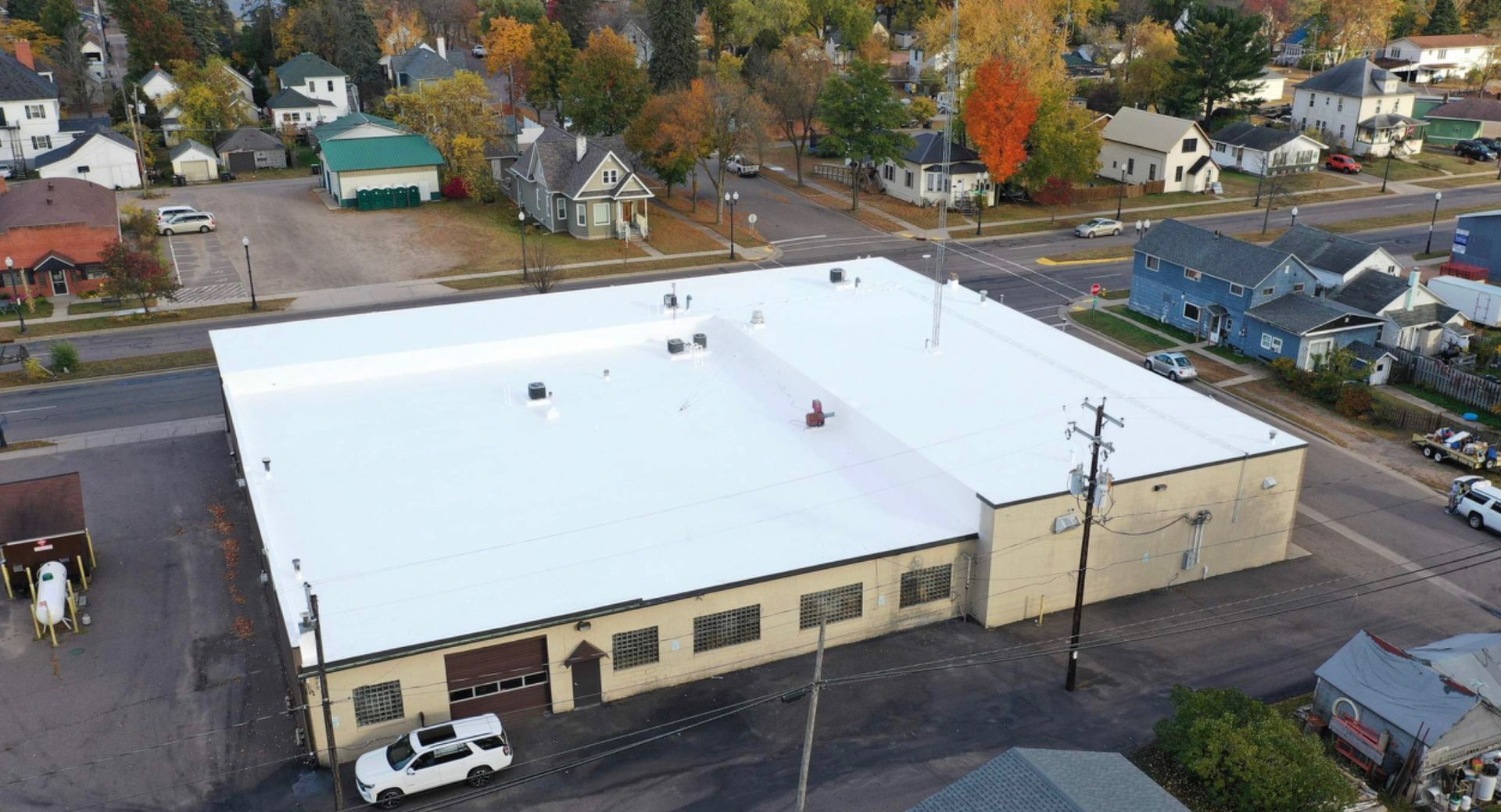
We put 80-mil TPO on a 25,000 SF medical office building in Woodbury, MN last year. The building owner originally wanted the cheapest option — 45-mil TPO. We talked him out of it. In this climate, the thinner membrane would start showing fatigue cracking within 10 years. The 80-mil costs a bit more per square foot but it's going to hold up under the freeze-thaw cycling that eats thinner membranes alive out here. He agreed once we showed him what thin TPO looks like after a few WI/MN winters on a building down the road.
What is EPDM roofing?
EPDM (Ethylene Propylene Diene Monomer) is a black synthetic rubber membrane. It's been used on commercial roofs since the 1960s and has the longest track record of any single-ply system. Seams are adhesive-bonded or tape-bonded (not heat-welded).
Strengths: excellent flexibility in extreme cold (stays pliable down to -40°F), proven long-term durability, lower material cost, and superior hail resistance due to rubber elasticity. Performs well in WI/MN winter conditions because it doesn't become brittle.
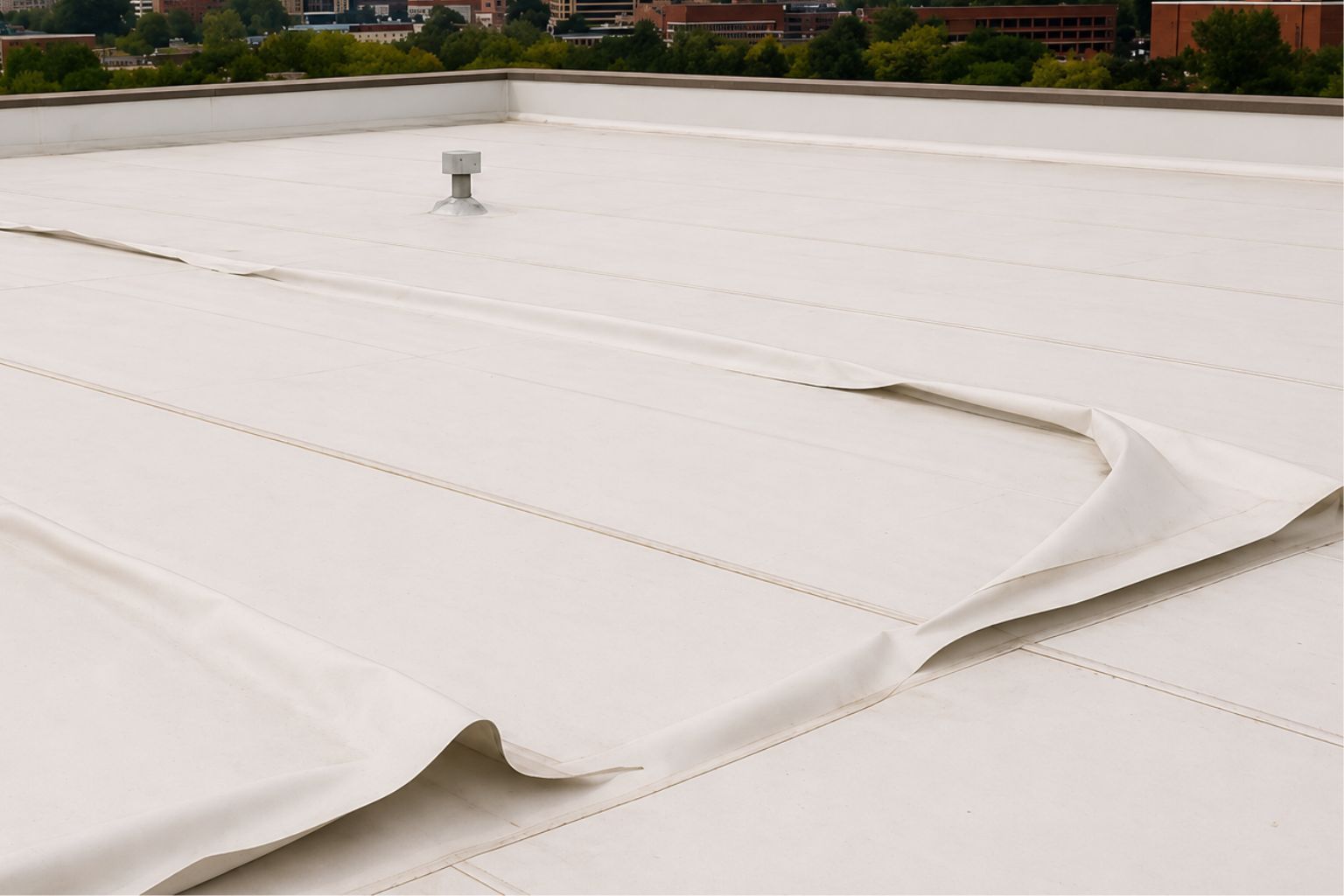
Weaknesses: black surface absorbs heat — higher cooling costs in summer and accelerated thermal cycling stress. Seams are the weak point — adhesive bonds degrade over time, especially under freeze-thaw cycling. EPDM surfaces chalk and erode under UV exposure over 15+ years. Not chemical-resistant — kitchens, restaurants, and buildings with rooftop grease exhaust should avoid it.
Typical lifespan: 20-30 years for the membrane surface, but seam repairs typically start at 10-15 years.
Best for: buildings in cold climates where winter flexibility matters more than energy efficiency. Warehouses, storage facilities, and buildings without significant cooling loads.
What is PVC roofing?
PVC (Polyvinyl Chloride) is a white, heat-weldable membrane similar to TPO but with different chemistry. It contains plasticizers that keep it flexible and has built-in chemical resistance that TPO and EPDM lack.
Strengths: best chemical resistance of the three — handles grease, oils, animal fats, and chemical fumes without degrading. Heat-welded seams like TPO. White reflective surface. Strong fire rating. Good puncture resistance.
Weaknesses: highest material cost of the three. The plasticizers that keep PVC flexible break down over time (plasticizer migration), making older PVC membranes brittle and crack-prone — especially in cold climates. Not as flexible as EPDM in extreme cold. Thinner PVC membranes (50 mil) are vulnerable to fatigue cracking in WI/MN temperature extremes.
Typical lifespan: 20-30 years, but quality varies significantly by manufacturer and thickness. Premium PVC (60-80 mil) outperforms budget PVC dramatically in cold climates.
Best for: restaurants, commercial kitchens, food processing, manufacturing facilities with chemical exhaust, and any building where rooftop grease or chemical exposure is a factor.
We installed PVC on a food processing facility in Eau Claire, WI specifically because of the rooftop grease exhaust. The previous EPDM membrane had deteriorated around the exhaust vents — the grease was literally eating the rubber. TPO would have had the same problem. PVC was the only membrane that could handle the chemical exposure, and it's held up exactly as expected. If your building has kitchen exhaust or chemical fumes hitting the roof, don't try to save money with a cheaper membrane. You'll replace it twice in the time PVC lasts once.
How do they compare in WI/MN winters?
This is the question that matters most for buildings in our service area. Here's how each material handles the specific stresses of a Western Wisconsin / Eastern Minnesota winter:
Freeze-thaw seam stress: EPDM seams (adhesive) are most vulnerable — cold weakens the bond. TPO and PVC seams (heat-welded) hold up better but can crack at weld lines after years of cycling. Advantage: TPO/PVC when new, but all three develop seam issues over time.
Extreme cold flexibility: EPDM stays flexible to -40°F. TPO and PVC become rigid below 0°F, increasing puncture risk from foot traffic or falling debris during cold-weather maintenance. Advantage: EPDM.
Snow load performance: All three handle snow load comparably — the difference is in the deck and insulation design, not the membrane. No significant advantage.
Ice dam resistance: Ice forming against parapets and drains stresses all membranes. EPDM's flexibility helps it accommodate ice movement. TPO and PVC's rigidity in cold means ice shifts can crack the membrane at contact points. Advantage: EPDM.
Thermal cycling fatigue: 170+ degree annual swings (from -20°F to 150°F+ surface temperature in summer sun) fatigue every membrane over time. EPDM's rubber chemistry handles cycling better than TPO's polyolefin or PVC's plasticized vinyl. Advantage: EPDM.
For a deeper look at what winter specifically does to these systems, see our guide on what to inspect on your commercial roof after a WI/MN winter.
How do the costs compare?
Exact costs depend on building size, roof complexity, number of penetrations, and access conditions. What we can tell you is the relative positioning:
TPO is the mid-range option — the best balance of cost and performance for most commercial buildings.
EPDM has the lowest material cost of the three, though adhesive seam labor can offset savings on complex roofs with many penetrations.
PVC carries a premium price point, justified by its chemical resistance and fire rating. It costs more upfront but outperforms in demanding environments.
Before committing to any full replacement, make sure restoration isn't viable. A fabric-reinforced restoration over an existing membrane can save substantially if the underlying system is sound. See our fabric-reinforced vs single-ply comparison for the full decision logic.
Which one should you choose?
Choose TPO if: you want the best balance of cost and performance for a standard commercial building with no special chemical exposure, your budget is moderate, and energy efficiency matters. Specify 60 mil minimum — 80 mil in high-traffic areas.
Choose EPDM if: your building is in a particularly exposed location, cold-weather flexibility is your top priority, you're roofing a warehouse or storage facility with minimal cooling load, or you want the lowest upfront cost. Accept that seam maintenance will be an ongoing line item.
A cold storage warehouse in Baldwin, WI is a good example. The building owner needed a membrane that wouldn't crack in January when it's -15°F outside and the building interior is kept at 35°F. There's no cooling load to speak of, so the black surface wasn't a drawback. EPDM was the right call — it stays flexible in the extreme cold while TPO and PVC would have been stiff as plywood during the worst months. We told him upfront: plan on seam maintenance every 8-10 years. That's the tradeoff with EPDM, and he was fine with it.
Choose PVC if: your building has rooftop grease exhaust, chemical exposure, or special fire rating requirements. Pay the premium — in these environments, PVC outperforms TPO and EPDM by years.
Choose none of the above if: your existing roof can be restored instead of replaced. Not every aging roof needs a new single-ply membrane. If the insulation is dry and the deck is sound, fabric-reinforced restoration may extend your roof's life 15-20 years at a fraction of the replacement cost. When restoration isn't viable, our guide on when fabric-reinforced is the wrong choice explains why.
The best way to find out? Get on the roof — or let us do it.
→ Schedule a free commercial roof inspection and we'll tell you what system your building needs, what it'll cost, and whether you even need a new roof at all.
Walk it yourself first with our commercial roof inspection checklist.
Frequently Asked Questions
Is TPO or EPDM better for Wisconsin winters?
EPDM handles extreme cold better because it stays flexible to -40°F while TPO becomes rigid. But TPO's heat-welded seams outperform EPDM's adhesive seams in freeze-thaw cycling. Neither is universally "better" — it depends on whether cold flexibility or seam durability matters more for your specific building.
How thick should TPO or PVC be in a cold climate?
60 mil minimum, 80 mil recommended for buildings with frequent rooftop traffic or extreme weather exposure. Thinner membranes (45-50 mil) save money upfront but develop fatigue cracking sooner in cold climates. The cost difference between 60 mil and 80 mil is modest — worth it over a 20-year lifespan.
Can you coat an existing TPO, EPDM, or PVC roof instead of replacing it?
Yes — if the membrane is still adhered and the insulation is dry. Fabric-reinforced coatings bond to all three membrane types and can extend life 15-20 years. This is significantly cheaper than tear-off and replacement. An inspection determines whether your specific roof qualifies.
Why are EPDM seams the weak point?
EPDM seams use adhesive or tape bonding rather than heat welding. Adhesive bonds weaken over time from UV exposure, moisture, and freeze-thaw cycling. After 10-15 years in WI/MN, seam failures become the primary maintenance issue on EPDM roofs. TPO and PVC seams are heat-welded — a fundamentally stronger bond method.
Does membrane color really affect energy costs?
Yes. White membranes (TPO, PVC) reflect 80-90% of solar radiation. Black EPDM absorbs it. On a 20,000 SF commercial building in the Upper Midwest, the cooling cost difference is real and compounds over the life of the roof.